# How Bittensor's Proposed Shorting Mechanism Would Actually Work
*This describes a protocol specification circulating in the Bittensor community as of July 2026. It hasn't shipped, and the document itself says plainly it isn't production-ready yet. This is the design, not what's live, and that could change before it ships or instead of shipping.*
**What's actually new**
Every position on Bittensor today is the same shape: buy Alpha, hope it goes up, sell later for more TAO than you put in. There's no way to act on "I think this subnet is weak" except not buying, or selling what you already hold. This spec adds a way to bet directly that a subnet's Alpha will fall. That's a short.
**Not the usual way shorting works**
On most platforms, shorting means borrowing an asset from someone else, selling it, then later buying it back (hopefully cheaper) to hand back to the lender, keeping the difference. That needs a lender.
This design has no lender. The subnet's own pool manufactures the short for you.
**How it actually works**
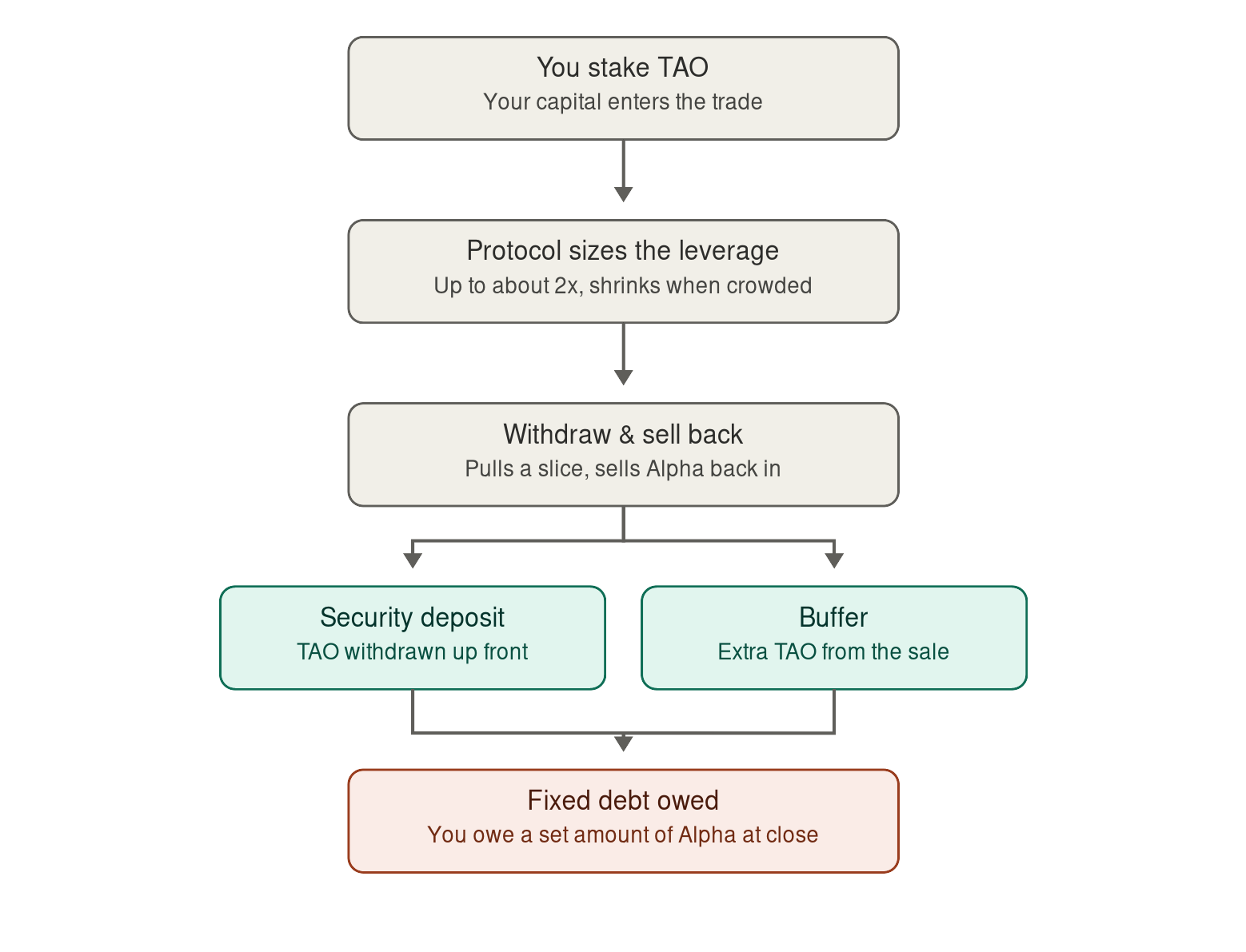
You put in an amount. Call it your stake. Behind the scenes, the protocol works out a bigger position than your stake alone would buy on the spot market. That's leverage. You don't choose how much: the protocol sets it (roughly up to double your stake, in the initial numbers) and shrinks it automatically when that side of the pool is already crowded with other shorts.
With that bigger figure, the protocol does something concrete to the subnet's pool: it pulls out a slice of both TAO and Alpha, proportional to your position, as if briefly withdrawing a sliver of the whole pool. The withdrawn Alpha then gets sold straight back into the pool, which is now slightly thinner than before. Selling into a thinner pool gets less TAO than the original price would suggest, and that gap splits into two separate pots, not one:
- The TAO withdrawn at the very start is held aside as a security deposit backing the trade.
- The extra TAO generated from selling the Alpha back in becomes your buffer: the thing that actually pays for holding the trade open.
Neither pot is handed to you. Both sit locked inside the position. In exchange, you now owe the protocol a fixed amount of that subnet's Alpha (not a dollar figure, an exact token count) whenever you close.
**Carry: the cost of holding the bet open**
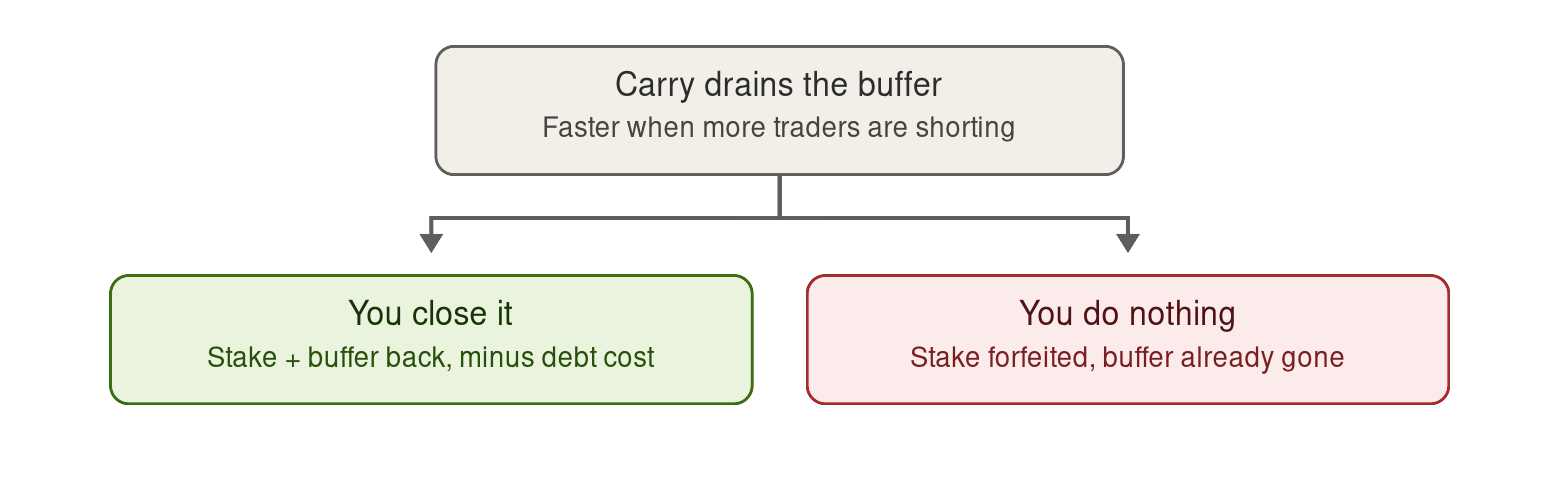
Your buffer isn't static. It drains a little every day. That daily drain is called carry, and it tracks crowding: the more people shorting the same subnet at once, the faster it goes. It can get steep. At maximum crowding, held for a full year, well under half a percent of the buffer would be left.
**No liquidation price isn't the same as no risk**
On most leveraged products there's a specific price where you get force-closed (a liquidation price), and if the market hits it, you're out, often at the worst moment. This design has none of that. Nobody can trigger your exit.
But there's a catch. If you never close the position yourself and just let the buffer drain to nothing, it doesn't quietly end at no cost to you. It defaults, and your original stake gets swept away to the protocol instead of handed back. The document says this outright, in the same breath as explaining when it's worth closing: "at default, [your stake] is recycled outside the pool."
So the real distinction isn't safe versus risky. It's active versus passive. Close it yourself, win or lose, and you get back whatever's left of your stake and buffer, minus the cost of buying back what you owe. Ignore it, and you lose your stake on top of whatever the buffer already cost you. Removing the liquidation trigger doesn't remove the risk. It moves the responsibility from the market forcing you out to you deciding when to leave.
**If the subnet dies while you're still in the trade**
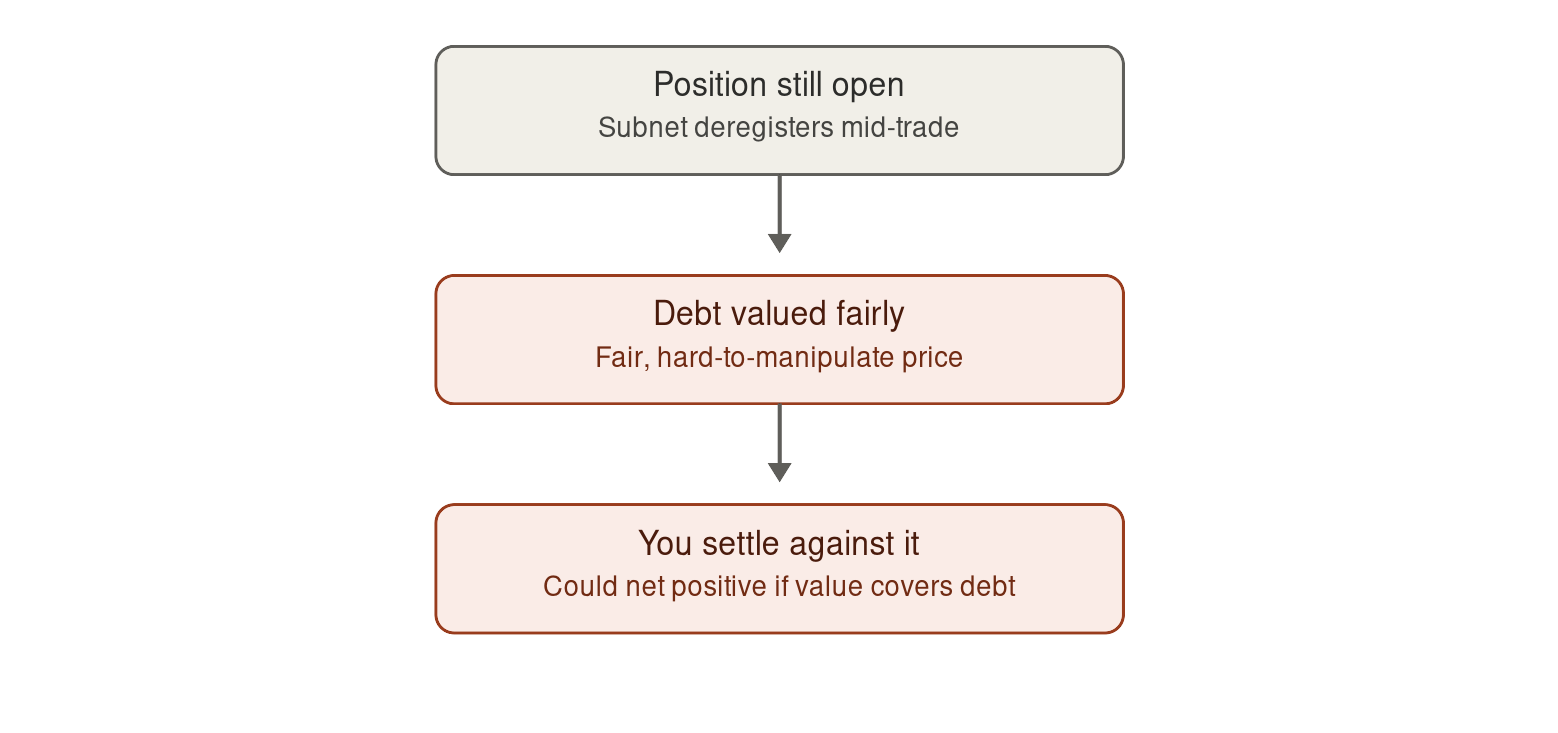
You don't walk away for free just because the thing you bet against no longer exists. Your debt gets valued at a fair, hard-to-manipulate price, and you settle against it. You could even come out with money left over, if what you're still holding is worth more than what you owe.
**What's live and what isn't**
Only the short side is specified to launch first. The mirror version, betting a subnet goes up using this same mechanism, is built into the design but switched off until it's tested separately. And the whole thing is explicitly marked pre-launch, not a shipped feature.